


Thursday, March 19, 2026
HomeData ScienceData Engineering: DWH and Big DataTalend ETL Introduction – Complete Guide for Beginners

Talend ETL Introduction – Complete Guide for Beginners

Talend ETL Introduction: The Visual Data Integration Platform That Makes Complex Pipelines Manageable

There’s a specific frustration that data professionals know intimately—a frustration that reveals the gap between what needs to happen with data and how hard it is to make it happen.

You need to pull customer records from an Oracle database, combine them with transaction data from SQL Server, enrich everything with reference data from Excel spreadsheets, apply business logic to clean and standardize formats, handle errors gracefully, and load the results into a data warehouse—all on an automated schedule that runs reliably every night.

Writing custom code for this workflow means hundreds of lines across multiple scripts, managing database connections manually, implementing error handling from scratch, debugging when things break at 3 AM, and maintaining everything as requirements inevitably change.

There has to be a better way than reinventing data integration logic every single time.

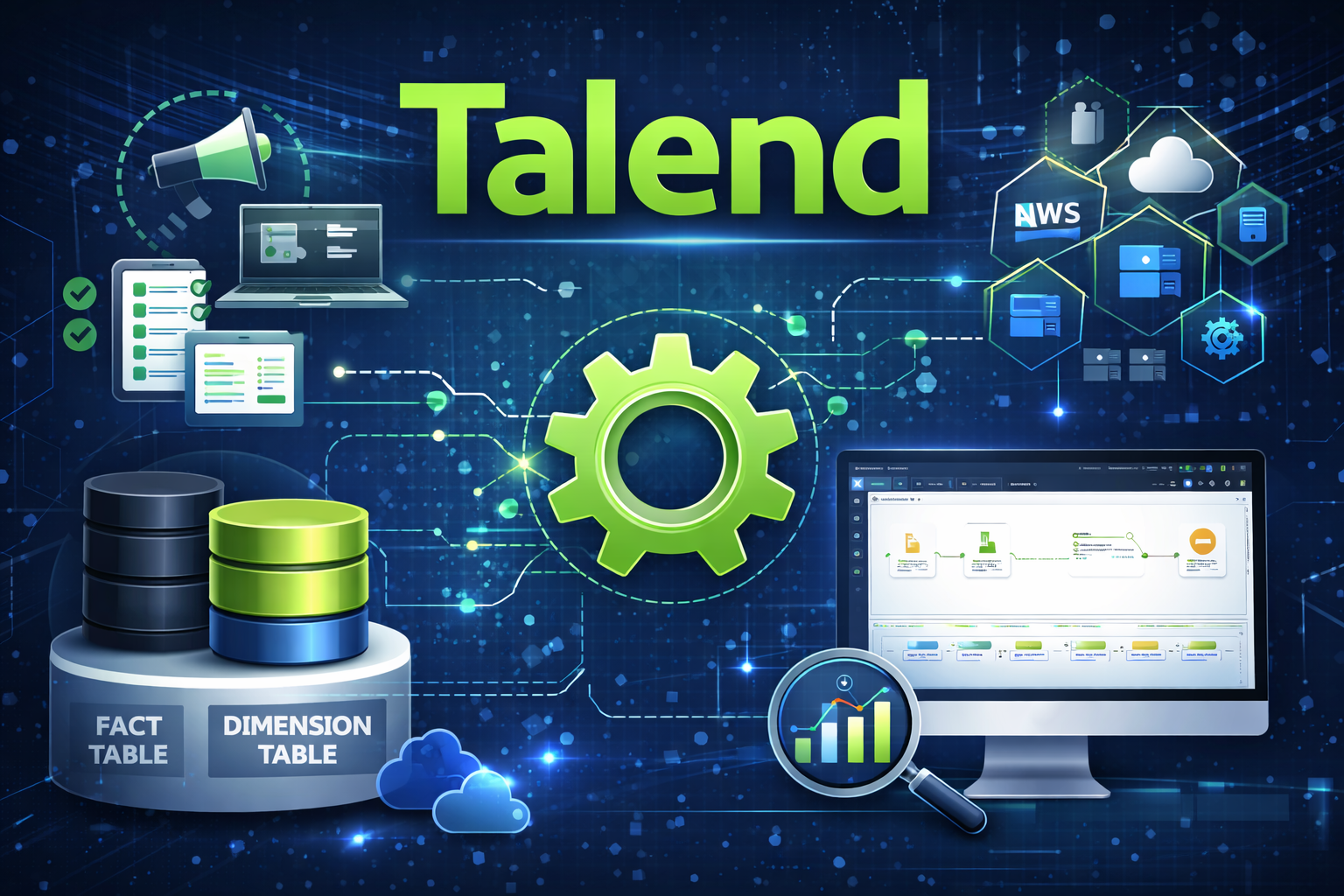
Talend ETL is that better way—a visual platform that transforms complex data integration workflows into manageable, maintainable, reusable components you design graphically rather than code manually.

For students, data engineers, and BI developers in Pakistan entering the data field, understanding tools like Talend isn’t about avoiding coding (though that’s a benefit)—it’s about working at the right abstraction level where you focus on business logic and data transformations rather than low-level plumbing.

At Dicecamp, we teach Talend not as a code replacement but as the professional tool that makes enterprise data integration practical at scale.

The Problem Talend Solves

To appreciate why ETL tools like Talend exist, understand what building data pipelines without them actually requires.

Imagine you’re extracting data from three different sources—a MySQL customer database, a PostgreSQL inventory system, and CSV sales files dropped daily to an SFTP server. You need to:

Establish and manage connections to each system with proper authentication. Read data efficiently without overwhelming source systems. Handle connection failures and retry logic. Parse CSV files accounting for encoding issues and format variations. Join data from different sources despite mismatched schemas and data types. Apply transformations—date formatting, string cleaning, business rules, calculations. Handle missing data, duplicates, and constraint violations. Load results into your data warehouse with appropriate error handling. Log everything for monitoring and troubleshooting. Schedule the entire process to run automatically.

Writing this from scratch in Python or Java means managing every detail explicitly. Database connection pooling. Transaction management. Error handling at every step. Schema evolution over time. Performance optimization. It’s hundreds of lines of code that have nothing to do with your actual business logic—just infrastructure plumbing.

And when requirements change (they always do), you’re modifying code, testing thoroughly, worrying about introducing bugs in production pipelines that might silently corrupt data.

Talend abstracts away this plumbing. Instead of writing connection management code, you configure connection components. Instead of coding transformation logic line by line, you design flows visually using pre-built transformation components. Instead of implementing error handling from scratch, you configure how the system should handle errors using built-in patterns.

You still need to understand what’s happening under the hood—good ETL developers aren’t just clicking buttons. But you work at a higher level of abstraction, focusing on business requirements rather than technical implementation details.

What Talend Actually Is

Talend is a comprehensive data integration platform, but most people encounter it first through Talend Open Studio—the free, open-source ETL development environment.

Open Studio provides a visual interface where you design data integration jobs by dragging components onto a canvas and connecting them to define data flow. Each component represents a specific operation—reading from a database, transforming data, writing to a file, joining datasets, filtering rows.

The components are pre-built and tested. The tMySQLInput component knows how to connect to MySQL databases, handle connection pooling, and stream results efficiently. The tMap component provides sophisticated transformation capabilities—joins, filters, expressions, data type conversions. The tFileOutputDelimited component writes CSV files with configurable formatting.

You don’t code these operations—you configure them. Set connection parameters. Define which columns to read. Specify transformation logic. Map source columns to target columns. Configure error handling behavior.

Behind the scenes, Talend generates actual code—typically Java—that implements your design. You can review this generated code, understanding exactly what executes when your job runs. But you don’t maintain that code directly. You maintain the visual design, and Talend regenerates code as needed.

This approach provides several advantages:

Faster development because you’re not writing boilerplate code. Better maintainability because visual flows are easier to understand than hundreds of lines of code. Built-in best practices because components implement proven patterns. Reusability because jobs become templates you can adapt for similar needs.

The platform scales from simple file conversions to complex enterprise data integration workflows processing billions of records.

Understanding the ETL Process Through Talend

ETL—Extract, Transform, Load—isn’t just Talend terminology. It’s the fundamental pattern for data integration, and understanding it conceptually is as important as knowing any specific tool.

Extract means reading data from source systems without disrupting their normal operations. Sources might be databases (Oracle, MySQL, PostgreSQL, SQL Server), files (CSV, Excel, JSON, XML), APIs (REST, SOAP), cloud platforms (Salesforce, AWS S3), or custom applications. Each source has quirks—connection requirements, data formats, performance characteristics, access limitations.

Talend’s extraction components handle this diversity. The tOracleInput component understands Oracle-specific connection strings and SQL syntax. The tRESTClient component manages HTTP requests and authentication. The tFileInputDelimited component parses CSV files accounting for delimiters, quotes, and escape characters.

You configure these components rather than writing parsing and connection logic from scratch.

Transform is where business logic lives—the rules that clean, standardize, enrich, and restructure data to meet target requirements. This includes:

Data cleansing: removing duplicates, handling nulls, correcting format errors. Standardization: converting dates to consistent formats, normalizing addresses, applying naming conventions. Business rules: calculating fields, categorizing records, applying validation logic. Enrichment: joining reference data, looking up values, adding derived columns.

Talend’s tMap component is the transformation workhorse. It provides a visual mapper where you define joins between inputs, write expressions to calculate values, filter rows based on conditions, and route data to multiple outputs. Complex transformation logic that might be 50 lines of Python becomes a visual flow in tMap.

Other transformation components handle specific needs: tFilterRow for filtering, tAggregate for aggregations, tNormalize for splitting delimited values, tDenormalize for pivoting data.

Load moves transformed data into target systems—data warehouses (Teradata, Snowflake, Redshift), databases, files, APIs, or analytics platforms. Loading includes handling errors gracefully, managing transactions, optimizing for performance, and logging what got loaded.

Talend’s output components implement loading patterns. The tTeradataOutput component uses Teradata’s bulk loading utilities for performance. The tFileOutputDelimited writes files with configurable formatting. The tLogRow component helps debugging by displaying data flow.

This Extract-Transform-Load sequence is the universal pattern for data integration. Talend makes implementing it visual and manageable.

The Power of Visual Design

Talend’s visual approach isn’t just about making things easier—it changes how teams collaborate on data integration.

A visual job design is documentation. New team members can look at a Talend job and understand data flow immediately—what sources, what transformations, what targets. The flow diagram communicates intent far better than code comments buried in scripts.

Business analysts can participate in design review. They might not code, but they can verify a visual flow implements business requirements correctly. “The customer data comes from CRM, gets enriched with loyalty tier from the database, filters to active customers, and loads to the warehouse” is visible in the flow diagram.

Changes become discussions about flow, not debugging code. When requirements change, you modify the visual design collaboratively. “We need to add product category as a join condition here, and route high-value transactions to a different target there.” The conversation happens at the business logic level.

Troubleshooting improves because you can add logging components anywhere in the flow, run jobs in debug mode watching data transform step-by-step, and identify exactly where issues occur. Instead of debugging abstract code, you’re debugging visible data transformations.

Reusability increases because jobs become templates. Build a generic “load dimension table” job, then configure it for different dimension tables through parameters. Build a “customer data integration” template, then adapt it for different source systems.

The visual approach doesn’t eliminate the need to understand data integration concepts deeply—you still need to know when to use specific join types, how to handle slowly changing dimensions, how to optimize for performance. But it lets you express that knowledge visually and maintainably.

Talend Components: The Building Blocks

Understanding common Talend components helps you recognize what’s possible and how to approach different integration scenarios.

Input components read from sources:

  • tMySQLInput, tOracleInput, tPostgreSQLInput for databases
  • tFileInputDelimited for CSV, tFileInputExcel for Excel
  • tRESTClient for API calls
  • tS3Input for AWS S3 files

Each handles source-specific connection, authentication, and data retrieval patterns.

Transformation components modify data:

  • tMap for complex joins, filters, and calculations
  • tFilterRow for simple row filtering
  • tAggregate for GROUP BY operations
  • tJoin for joining datasets
  • tNormalize and tDenormalize for restructuring

These implement common transformation patterns without custom code.

Output components write to targets:

  • Database outputs matching input components
  • tFileOutputDelimited for CSV
  • tTeradataFastLoad for high-speed warehouse loading
  • tLogRow for debugging and monitoring

Flow control components manage workflow:

  • tRunJob to call other jobs
  • tIf for conditional logic
  • tLoop for iterations
  • tFileExist to check for files

Utility components handle common needs:

  • tJavaRow for custom Java code when needed
  • tWarn and tDie for error handling
  • tStatCatcher for job monitoring
  • tPrejob and tPostjob for setup and cleanup

Learning which components solve which problems is key to effective Talend development. You’re not memorizing syntax—you’re building a mental toolkit of patterns.

Talend in the Data Warehouse Context

Talend frequently appears in data warehousing workflows, where its strengths align perfectly with warehouse requirements.

The typical warehouse ETL pattern:

Extract from multiple operational systems—ERP databases, CRM systems, legacy applications, external data feeds. Each source has different schemas, update patterns, and data quality issues. Talend’s diverse input components handle this source heterogeneity.

Transform to warehouse structures—dimension tables with slowly changing dimension logic, fact tables with appropriate grain and aggregations, conforming dimensions across business processes. Talend’s tMap enables the complex logic dimensional modeling requires.

Load into warehouse tables—often Teradata, Snowflake, or Redshift. Talend includes components optimized for these platforms, using bulk loading utilities for performance rather than row-by-row insertion.

Schedule for automated execution—nightly loads, hourly refreshes, or real-time streaming. Talend jobs integrate with scheduling tools or Talend’s own job orchestration for reliable automation.

Monitor for data quality and job success—logging what loaded, error handling for bad data, alerting when jobs fail. Talend’s built-in monitoring components make this straightforward.

This warehouse context is where many data engineers encounter Talend professionally, and where its visual design and component library prove most valuable.

Why Talend Skills Matter in Pakistan’s Market

Pakistan’s organizations increasingly build data warehouses and analytics platforms to support decision-making. These initiatives require ETL capabilities—moving data from operational systems into analytical structures.

Talend appears frequently in enterprise contexts, particularly in banking, telecommunications, and retail where data volumes and complexity justify investment in professional ETL tools. Organizations using Teradata warehouses often use Talend for ETL due to tight integration.

Job postings for Data Engineers and ETL Developers frequently list Talend as required or preferred experience. The tool is common enough that proficiency signals practical data integration experience, not just theoretical knowledge.

Salary premiums for Talend skills are substantial—30-50% higher than basic database skills because Talend expertise enables complex data integration projects that have direct business value.

International companies with Pakistan operations often standardize on tools like Talend globally, creating opportunities for Pakistani engineers to work on international data platforms remotely or relocate.

Beyond immediate career benefits, Talend teaches data integration concepts—ETL patterns, data quality handling, performance optimization, error management—that transfer to other tools and custom development when needed.

The Dicecamp Learning Approach

Reading about Talend teaches you what’s possible. Building actual integration jobs teaches you how to solve real problems.

At Dicecamp, Talend training emphasizes hands-on development with realistic scenarios: extracting from multiple database types, transforming messy real-world data, loading into warehouses, handling errors gracefully, optimizing for performance, integrating into automated workflows.

You’ll work through progressively complex jobs—simple file conversions, multi-source data integration, slowly changing dimension logic, complex business rules, performance tuning for large datasets.

By training’s end, Talend won’t be an abstract tool—it’ll be practical capability you can deploy on real data integration challenges.

🎓 Explore Dicecamp – Start Your Data Engineering Journey Today

Whether you’re a student, working professional, or career switcher in Pakistan, Dicecamp provides structured learning paths to help you master Data Engineering Infrastructure with real-world skills.

Choose the learning option that fits you best:

🚀 Data Engineer Paid Course (Complete Professional Program)

A full, in-depth DevOps training program covering Virtualization, Linux, Cloud, CI/CD, Docker, Kubernetes, and real projects. Ideal for serious learners aiming for jobs and freelancing.

👉 Click here for the Data Engineer specialized Course.


🎁 Data Engineer Free Course (Beginner Friendly)

New to DevOps or IT infrastructure? Start with our free course and build your foundation in Linux, Virtualization, and DevOps concepts.

👉 Click here for the Data Engineer (Big Data) free Course.


Your Next Move

Data integration is unglamorous work that makes analytics possible. Without reliable ETL, warehouses contain stale or incorrect data. Reports mislead. Decisions suffer.

Tools like Talend make integration manageable at enterprise scale—visual, maintainable, and powerful enough for complex real-world requirements.

For data professionals in Pakistan, Talend represents practical skills with immediate market value. Organizations need people who can build and maintain the data pipelines that feed their analytics.

Whether you’re starting your data engineering journey or adding to existing skills, Talend expertise is practical capability that translates directly to employment and project contribution.

At Dicecamp, we’re ready to help you build that capability through hands-on training emphasizing real integration scenarios.

Master Talend ETL with Dicecamp and build the data integration skills that power enterprise analytics.

📲 Message Dice Analytics on WhatsApp for more information:
https://wa.me/923405199640


Common Questions About Talend ETL

Do I need programming knowledge to use Talend?
Basic understanding of data concepts and SQL helps significantly, but you don’t need to be a programmer. Talend’s visual interface makes it accessible to data analysts and business intelligence professionals. That said, understanding what generated code does and being able to write custom expressions when needed makes you far more effective.

How is Talend different from writing custom Python or Java ETL scripts?
Talend generates code (often Java) but lets you work visually at a higher abstraction level. You focus on data flow and business logic rather than connection management, error handling, and infrastructure plumbing. For complex jobs, Talend can be faster to develop and easier to maintain. For simple tasks, custom scripts might be simpler. Choose based on complexity and maintainability needs.

Is Talend Open Studio enough for professional work, or do I need paid versions?
Open Studio is fully functional and used professionally for many scenarios. Paid versions (Data Fabric, Data Management Platform) add enterprise features like advanced scheduling, cloud deployments, data quality tools, and collaboration capabilities. For learning and many production use cases, Open Studio is sufficient. Enterprise contexts might require paid versions.

Can Talend handle big data and real-time processing?
Yes, though it depends on version and deployment. Talend includes components for Hadoop, Spark, and Kafka integration supporting big data workflows. Real-time processing is possible through streaming jobs, though Talend’s traditional strength is batch ETL. For very high-volume real-time requirements, specialized streaming platforms might be more appropriate than Talend.

RELATED ARTICLES

LEAVE A REPLY

Please enter your comment!
Please enter your name here

Most Popular

Talend ETL Introduction – Complete Guide for Beginners

Talend ETL Introduction: The Visual Data Integration Platform That Makes Complex Pipelines Manageable

There’s a specific frustration that data professionals know intimately—a frustration that reveals the gap between what needs to happen with data and how hard it is to make it happen.

You need to pull customer records from an Oracle database, combine them with transaction data from SQL Server, enrich everything with reference data from Excel spreadsheets, apply business logic to clean and standardize formats, handle errors gracefully, and load the results into a data warehouse—all on an automated schedule that runs reliably every night.

Writing custom code for this workflow means hundreds of lines across multiple scripts, managing database connections manually, implementing error handling from scratch, debugging when things break at 3 AM, and maintaining everything as requirements inevitably change.

There has to be a better way than reinventing data integration logic every single time.

Talend ETL is that better way—a visual platform that transforms complex data integration workflows into manageable, maintainable, reusable components you design graphically rather than code manually.

For students, data engineers, and BI developers in Pakistan entering the data field, understanding tools like Talend isn’t about avoiding coding (though that’s a benefit)—it’s about working at the right abstraction level where you focus on business logic and data transformations rather than low-level plumbing.

At Dicecamp, we teach Talend not as a code replacement but as the professional tool that makes enterprise data integration practical at scale.

The Problem Talend Solves

To appreciate why ETL tools like Talend exist, understand what building data pipelines without them actually requires.

Imagine you’re extracting data from three different sources—a MySQL customer database, a PostgreSQL inventory system, and CSV sales files dropped daily to an SFTP server. You need to:

Establish and manage connections to each system with proper authentication. Read data efficiently without overwhelming source systems. Handle connection failures and retry logic. Parse CSV files accounting for encoding issues and format variations. Join data from different sources despite mismatched schemas and data types. Apply transformations—date formatting, string cleaning, business rules, calculations. Handle missing data, duplicates, and constraint violations. Load results into your data warehouse with appropriate error handling. Log everything for monitoring and troubleshooting. Schedule the entire process to run automatically.

Writing this from scratch in Python or Java means managing every detail explicitly. Database connection pooling. Transaction management. Error handling at every step. Schema evolution over time. Performance optimization. It’s hundreds of lines of code that have nothing to do with your actual business logic—just infrastructure plumbing.

And when requirements change (they always do), you’re modifying code, testing thoroughly, worrying about introducing bugs in production pipelines that might silently corrupt data.

Talend abstracts away this plumbing. Instead of writing connection management code, you configure connection components. Instead of coding transformation logic line by line, you design flows visually using pre-built transformation components. Instead of implementing error handling from scratch, you configure how the system should handle errors using built-in patterns.

You still need to understand what’s happening under the hood—good ETL developers aren’t just clicking buttons. But you work at a higher level of abstraction, focusing on business requirements rather than technical implementation details.

What Talend Actually Is

Talend is a comprehensive data integration platform, but most people encounter it first through Talend Open Studio—the free, open-source ETL development environment.

Open Studio provides a visual interface where you design data integration jobs by dragging components onto a canvas and connecting them to define data flow. Each component represents a specific operation—reading from a database, transforming data, writing to a file, joining datasets, filtering rows.

The components are pre-built and tested. The tMySQLInput component knows how to connect to MySQL databases, handle connection pooling, and stream results efficiently. The tMap component provides sophisticated transformation capabilities—joins, filters, expressions, data type conversions. The tFileOutputDelimited component writes CSV files with configurable formatting.

You don’t code these operations—you configure them. Set connection parameters. Define which columns to read. Specify transformation logic. Map source columns to target columns. Configure error handling behavior.

Behind the scenes, Talend generates actual code—typically Java—that implements your design. You can review this generated code, understanding exactly what executes when your job runs. But you don’t maintain that code directly. You maintain the visual design, and Talend regenerates code as needed.

This approach provides several advantages:

Faster development because you’re not writing boilerplate code. Better maintainability because visual flows are easier to understand than hundreds of lines of code. Built-in best practices because components implement proven patterns. Reusability because jobs become templates you can adapt for similar needs.

The platform scales from simple file conversions to complex enterprise data integration workflows processing billions of records.

Understanding the ETL Process Through Talend

ETL—Extract, Transform, Load—isn’t just Talend terminology. It’s the fundamental pattern for data integration, and understanding it conceptually is as important as knowing any specific tool.

Extract means reading data from source systems without disrupting their normal operations. Sources might be databases (Oracle, MySQL, PostgreSQL, SQL Server), files (CSV, Excel, JSON, XML), APIs (REST, SOAP), cloud platforms (Salesforce, AWS S3), or custom applications. Each source has quirks—connection requirements, data formats, performance characteristics, access limitations.

Talend’s extraction components handle this diversity. The tOracleInput component understands Oracle-specific connection strings and SQL syntax. The tRESTClient component manages HTTP requests and authentication. The tFileInputDelimited component parses CSV files accounting for delimiters, quotes, and escape characters.

You configure these components rather than writing parsing and connection logic from scratch.

Transform is where business logic lives—the rules that clean, standardize, enrich, and restructure data to meet target requirements. This includes:

Data cleansing: removing duplicates, handling nulls, correcting format errors. Standardization: converting dates to consistent formats, normalizing addresses, applying naming conventions. Business rules: calculating fields, categorizing records, applying validation logic. Enrichment: joining reference data, looking up values, adding derived columns.

Talend’s tMap component is the transformation workhorse. It provides a visual mapper where you define joins between inputs, write expressions to calculate values, filter rows based on conditions, and route data to multiple outputs. Complex transformation logic that might be 50 lines of Python becomes a visual flow in tMap.

Other transformation components handle specific needs: tFilterRow for filtering, tAggregate for aggregations, tNormalize for splitting delimited values, tDenormalize for pivoting data.

Load moves transformed data into target systems—data warehouses (Teradata, Snowflake, Redshift), databases, files, APIs, or analytics platforms. Loading includes handling errors gracefully, managing transactions, optimizing for performance, and logging what got loaded.

Talend’s output components implement loading patterns. The tTeradataOutput component uses Teradata’s bulk loading utilities for performance. The tFileOutputDelimited writes files with configurable formatting. The tLogRow component helps debugging by displaying data flow.

This Extract-Transform-Load sequence is the universal pattern for data integration. Talend makes implementing it visual and manageable.

The Power of Visual Design

Talend’s visual approach isn’t just about making things easier—it changes how teams collaborate on data integration.

A visual job design is documentation. New team members can look at a Talend job and understand data flow immediately—what sources, what transformations, what targets. The flow diagram communicates intent far better than code comments buried in scripts.

Business analysts can participate in design review. They might not code, but they can verify a visual flow implements business requirements correctly. “The customer data comes from CRM, gets enriched with loyalty tier from the database, filters to active customers, and loads to the warehouse” is visible in the flow diagram.

Changes become discussions about flow, not debugging code. When requirements change, you modify the visual design collaboratively. “We need to add product category as a join condition here, and route high-value transactions to a different target there.” The conversation happens at the business logic level.

Troubleshooting improves because you can add logging components anywhere in the flow, run jobs in debug mode watching data transform step-by-step, and identify exactly where issues occur. Instead of debugging abstract code, you’re debugging visible data transformations.

Reusability increases because jobs become templates. Build a generic “load dimension table” job, then configure it for different dimension tables through parameters. Build a “customer data integration” template, then adapt it for different source systems.

The visual approach doesn’t eliminate the need to understand data integration concepts deeply—you still need to know when to use specific join types, how to handle slowly changing dimensions, how to optimize for performance. But it lets you express that knowledge visually and maintainably.

Talend Components: The Building Blocks

Understanding common Talend components helps you recognize what’s possible and how to approach different integration scenarios.

Input components read from sources:

  • tMySQLInput, tOracleInput, tPostgreSQLInput for databases
  • tFileInputDelimited for CSV, tFileInputExcel for Excel
  • tRESTClient for API calls
  • tS3Input for AWS S3 files

Each handles source-specific connection, authentication, and data retrieval patterns.

Transformation components modify data:

  • tMap for complex joins, filters, and calculations
  • tFilterRow for simple row filtering
  • tAggregate for GROUP BY operations
  • tJoin for joining datasets
  • tNormalize and tDenormalize for restructuring

These implement common transformation patterns without custom code.

Output components write to targets:

  • Database outputs matching input components
  • tFileOutputDelimited for CSV
  • tTeradataFastLoad for high-speed warehouse loading
  • tLogRow for debugging and monitoring

Flow control components manage workflow:

  • tRunJob to call other jobs
  • tIf for conditional logic
  • tLoop for iterations
  • tFileExist to check for files

Utility components handle common needs:

  • tJavaRow for custom Java code when needed
  • tWarn and tDie for error handling
  • tStatCatcher for job monitoring
  • tPrejob and tPostjob for setup and cleanup

Learning which components solve which problems is key to effective Talend development. You’re not memorizing syntax—you’re building a mental toolkit of patterns.

Talend in the Data Warehouse Context

Talend frequently appears in data warehousing workflows, where its strengths align perfectly with warehouse requirements.

The typical warehouse ETL pattern:

Extract from multiple operational systems—ERP databases, CRM systems, legacy applications, external data feeds. Each source has different schemas, update patterns, and data quality issues. Talend’s diverse input components handle this source heterogeneity.

Transform to warehouse structures—dimension tables with slowly changing dimension logic, fact tables with appropriate grain and aggregations, conforming dimensions across business processes. Talend’s tMap enables the complex logic dimensional modeling requires.

Load into warehouse tables—often Teradata, Snowflake, or Redshift. Talend includes components optimized for these platforms, using bulk loading utilities for performance rather than row-by-row insertion.

Schedule for automated execution—nightly loads, hourly refreshes, or real-time streaming. Talend jobs integrate with scheduling tools or Talend’s own job orchestration for reliable automation.

Monitor for data quality and job success—logging what loaded, error handling for bad data, alerting when jobs fail. Talend’s built-in monitoring components make this straightforward.

This warehouse context is where many data engineers encounter Talend professionally, and where its visual design and component library prove most valuable.

Why Talend Skills Matter in Pakistan’s Market

Pakistan’s organizations increasingly build data warehouses and analytics platforms to support decision-making. These initiatives require ETL capabilities—moving data from operational systems into analytical structures.

Talend appears frequently in enterprise contexts, particularly in banking, telecommunications, and retail where data volumes and complexity justify investment in professional ETL tools. Organizations using Teradata warehouses often use Talend for ETL due to tight integration.

Job postings for Data Engineers and ETL Developers frequently list Talend as required or preferred experience. The tool is common enough that proficiency signals practical data integration experience, not just theoretical knowledge.

Salary premiums for Talend skills are substantial—30-50% higher than basic database skills because Talend expertise enables complex data integration projects that have direct business value.

International companies with Pakistan operations often standardize on tools like Talend globally, creating opportunities for Pakistani engineers to work on international data platforms remotely or relocate.

Beyond immediate career benefits, Talend teaches data integration concepts—ETL patterns, data quality handling, performance optimization, error management—that transfer to other tools and custom development when needed.

The Dicecamp Learning Approach

Reading about Talend teaches you what’s possible. Building actual integration jobs teaches you how to solve real problems.

At Dicecamp, Talend training emphasizes hands-on development with realistic scenarios: extracting from multiple database types, transforming messy real-world data, loading into warehouses, handling errors gracefully, optimizing for performance, integrating into automated workflows.

You’ll work through progressively complex jobs—simple file conversions, multi-source data integration, slowly changing dimension logic, complex business rules, performance tuning for large datasets.

By training’s end, Talend won’t be an abstract tool—it’ll be practical capability you can deploy on real data integration challenges.

🎓 Explore Dicecamp – Start Your Data Engineering Journey Today

Whether you’re a student, working professional, or career switcher in Pakistan, Dicecamp provides structured learning paths to help you master Data Engineering Infrastructure with real-world skills.

Choose the learning option that fits you best:

🚀 Data Engineer Paid Course (Complete Professional Program)

A full, in-depth DevOps training program covering Virtualization, Linux, Cloud, CI/CD, Docker, Kubernetes, and real projects. Ideal for serious learners aiming for jobs and freelancing.

👉 Click here for the Data Engineer specialized Course.


🎁 Data Engineer Free Course (Beginner Friendly)

New to DevOps or IT infrastructure? Start with our free course and build your foundation in Linux, Virtualization, and DevOps concepts.

👉 Click here for the Data Engineer (Big Data) free Course.


Your Next Move

Data integration is unglamorous work that makes analytics possible. Without reliable ETL, warehouses contain stale or incorrect data. Reports mislead. Decisions suffer.

Tools like Talend make integration manageable at enterprise scale—visual, maintainable, and powerful enough for complex real-world requirements.

For data professionals in Pakistan, Talend represents practical skills with immediate market value. Organizations need people who can build and maintain the data pipelines that feed their analytics.

Whether you’re starting your data engineering journey or adding to existing skills, Talend expertise is practical capability that translates directly to employment and project contribution.

At Dicecamp, we’re ready to help you build that capability through hands-on training emphasizing real integration scenarios.

Master Talend ETL with Dicecamp and build the data integration skills that power enterprise analytics.

📲 Message Dice Analytics on WhatsApp for more information:
https://wa.me/923405199640


Common Questions About Talend ETL

Do I need programming knowledge to use Talend?
Basic understanding of data concepts and SQL helps significantly, but you don’t need to be a programmer. Talend’s visual interface makes it accessible to data analysts and business intelligence professionals. That said, understanding what generated code does and being able to write custom expressions when needed makes you far more effective.

How is Talend different from writing custom Python or Java ETL scripts?
Talend generates code (often Java) but lets you work visually at a higher abstraction level. You focus on data flow and business logic rather than connection management, error handling, and infrastructure plumbing. For complex jobs, Talend can be faster to develop and easier to maintain. For simple tasks, custom scripts might be simpler. Choose based on complexity and maintainability needs.

Is Talend Open Studio enough for professional work, or do I need paid versions?
Open Studio is fully functional and used professionally for many scenarios. Paid versions (Data Fabric, Data Management Platform) add enterprise features like advanced scheduling, cloud deployments, data quality tools, and collaboration capabilities. For learning and many production use cases, Open Studio is sufficient. Enterprise contexts might require paid versions.

Can Talend handle big data and real-time processing?
Yes, though it depends on version and deployment. Talend includes components for Hadoop, Spark, and Kafka integration supporting big data workflows. Real-time processing is possible through streaming jobs, though Talend’s traditional strength is batch ETL. For very high-volume real-time requirements, specialized streaming platforms might be more appropriate than Talend.

RELATED ARTICLES

LEAVE A REPLY

Please enter your comment!
Please enter your name here

Most Popular