


Thursday, March 12, 2026
HomeData ScienceData Engineering: DWH and Big DataSlowly Changing Dimensions (SCD) Explained | Data Warehousing Guide

Slowly Changing Dimensions (SCD) Explained | Data Warehousing Guide

Slowly Changing Dimensions (SCD): Preserving History in Data Warehouses That Change

There’s a deceptively simple question that reveals one of data warehousing’s fundamental challenges.

Your customer database shows that customer ID 12847, named Sarah Ahmed, lives in Lahore. Last month, she moved to Karachi and updated her address in your system. Today, you’re analyzing sales by customer location for the past two years.

Here’s the question: Should Sarah’s purchases from last year—when she lived in Lahore—be attributed to Lahore or Karachi?

The obvious answer seems to be Lahore, because that’s where she lived when she made those purchases. But your current customer record shows Karachi. If you simply overwrote her location when she moved, that historical context is gone. Every analysis now attributes all her historical purchases to Karachi, creating false insights about customer geography.

This isn’t a hypothetical problem—it’s the daily reality of data warehousing. Dimension data changes. Customers move. Employees change departments. Products shift categories. Suppliers update pricing. And every change creates a choice: preserve history or lose it forever.

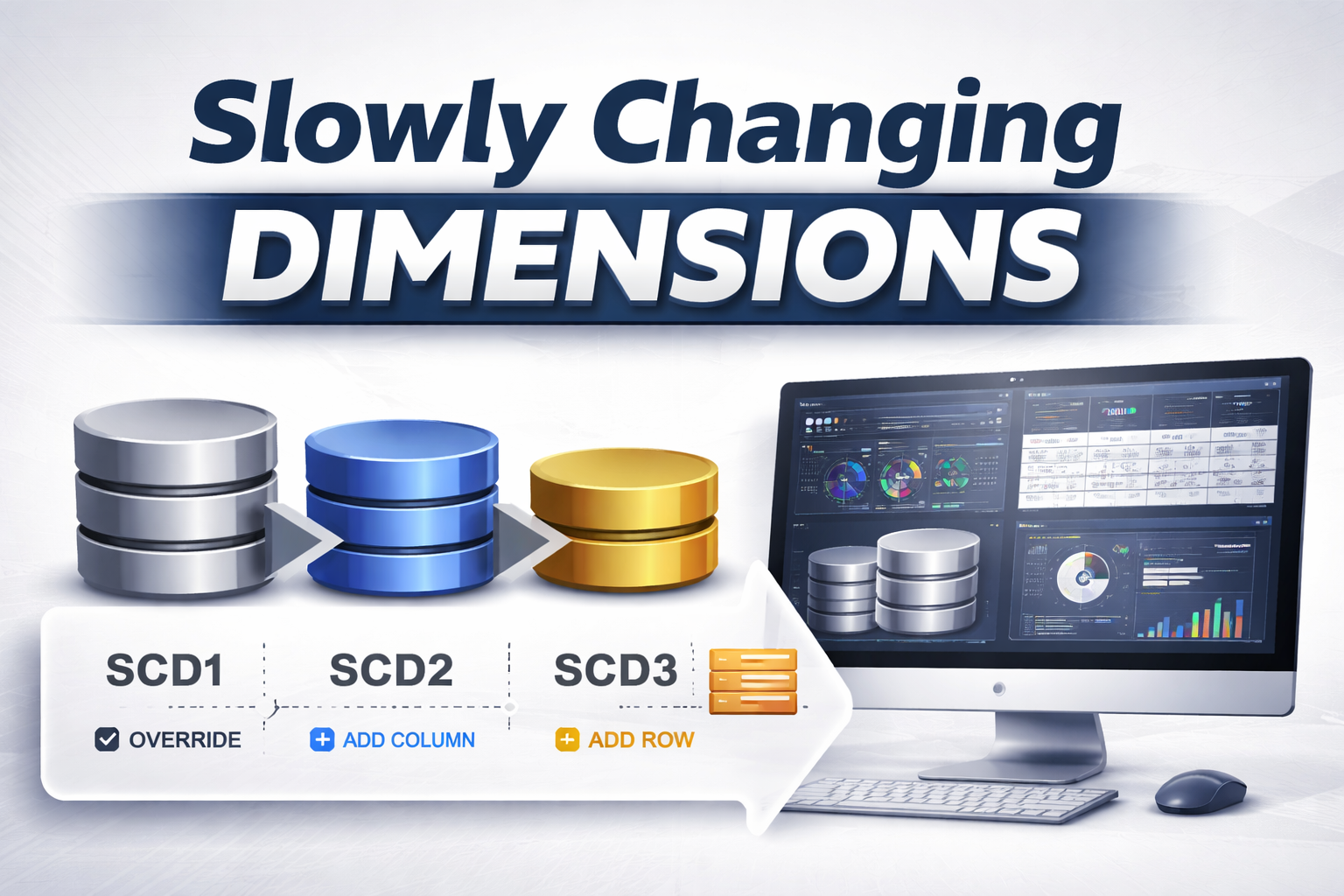
Slowly Changing Dimensions (SCD) are the structured techniques data warehousing uses to handle this challenge—maintaining accurate historical context while accommodating the reality that data changes over time.

For students, data engineers, and BI developers in Pakistan building warehouses that power business decisions, understanding SCD isn’t academic theory—it’s the practical discipline that determines whether your warehouse produces trustworthy insights or subtly misleading analysis.

At Dicecamp, we teach SCD not as abstract methodology but as the essential skill that makes dimensional data warehouses actually work for longitudinal analysis.

Why Dimensional Data Changes Matter

Before diving into SCD techniques, let’s establish why this problem is significant enough to require specialized handling.

In transactional systems—the operational databases running your business—current data is what matters. Your e-commerce site needs to know the customer’s current address for shipping. Your HR system needs the employee’s current department for payroll. Current state enables operations.

Data warehouses serve different purposes. They support analysis across time—trends, patterns, changes, historical performance. This temporal analysis depends critically on accurate historical context.

Consider sales analysis by product category. If a product moved from “Electronics” to “Smart Home” category six months ago, and you overwrite the category in your warehouse, all historical sales suddenly appear under “Smart Home”—even sales from years before smart home categories existed. Your trend analysis showing explosive smart home growth is fiction based on data that lost its historical context.

Or employee productivity analysis by department. Employees transfer between departments. If department changes overwrite history, high performers who transferred recently make their new departments look better retroactively and their old departments look worse. Managers get evaluated based on employees who weren’t even in their departments during the evaluation period.

These aren’t minor edge cases—they’re systematic distortions that make warehouse data unreliable for the very purpose it exists to serve: understanding business performance over time.

SCD techniques provide structured approaches to handling these changes while preserving the historical accuracy that makes warehouses valuable.

SCD Type 0: The Baseline—Things That Never Change

Before exploring how to handle changes, recognize that some dimension attributes genuinely never change and don’t require SCD handling.

Type 0 represents attributes that remain constant from creation. A person’s date of birth doesn’t change. A product’s initial launch date is fixed. A transaction’s original timestamp is immutable.

These attributes can be stored simply with no versioning, no historical tracking, no change management logic. They’re reference data that remains accurate across all time periods.

Identifying Type 0 attributes simplifies warehouse design by eliminating unnecessary complexity. Not everything needs SCD handling—only attributes that can legitimately change require it.

SCD Type 1: Overwrite and Lose History

Type 1 is the simplest change handling approach: when an attribute changes, overwrite the old value with the new one. History is lost completely.

When Sarah Ahmed moves from Lahore to Karachi, her customer record updates:

Before: Customer 12847 | Sarah Ahmed | Lahore
After:  Customer 12847 | Sarah Ahmed | Karachi

All queries now show Karachi, regardless of when the purchase occurred. Historical purchases made in Lahore appear as Karachi purchases. The context is gone.

This seems problematic, and for historical analysis it absolutely is. But Type 1 has legitimate use cases:

Correcting errors: If Sarah’s city was incorrectly recorded as “Lahroe” (typo), overwriting with “Lahore” is appropriate. The error was never valid, so preserving it as history has no value.

Attributes where history doesn’t matter: If you track a customer’s preferred contact method (email vs. phone), you might not care what it was historically—only what it is now. Type 1 overwrites work fine.

Performance-critical scenarios: Type 1 is simplest to implement and maintain, with the smallest storage footprint. When history truly doesn’t matter for the business question, Type 1’s simplicity is valuable.

The key is intentionality—use Type 1 only for attributes where losing history is acceptable or desirable, never as default laziness.

SCD Type 2: Preserve Full History Through Versioning

Type 2 is the most common and powerful SCD approach: when an attribute changes, create a new version of the dimension record while preserving the old version.

When Sarah moves, instead of overwriting:

Customer_Key | Customer_ID | Name        | City    | Effective_Start | Effective_End | Current_Flag
1001         | 12847       | Sarah Ahmed | Lahore  | 2022-01-01     | 2024-11-30   | N
1002         | 12847       | Sarah Ahmed | Karachi | 2024-12-01     | NULL         | Y

Notice what’s happened: Customer 12847 now has two records—two versions representing different periods of her history. The Customer_Key (surrogate key) differs between versions, while Customer_ID (natural key) remains constant.

Purchases from 2023 join to Customer_Key 1001, correctly showing Lahore. Purchases from 2025 join to Customer_Key 1002, correctly showing Karachi. The effective date ranges make temporal analysis accurate.

This approach preserves complete history. You can analyze:

Sales by customer location for any time period, with correct historical geography. Customer behavior changes after relocation. Employee performance within specific departments during specific periods. Product performance within historical category structures.

Type 2 handles the complexity that makes warehouses valuable for longitudinal analysis. The cost is storage—multiple versions consume more space—and ETL complexity—change detection and versioning logic requires careful implementation.

SCD Type 3: Limited History Through Additional Columns

Type 3 provides a middle ground: store current value and one or more previous values in additional columns.

Customer_ID | Name        | Current_City | Previous_City | City_Change_Date
12847       | Sarah Ahmed | Karachi      | Lahore        | 2024-12-01

This preserves some history—you know Sarah’s previous city and when it changed—but only the most recent change. If she moves again to Islamabad, Lahore disappears completely, replaced by Karachi as the previous city.

Type 3 suits scenarios where:

Limited history suffices: You need to track current and immediately prior state, but deeper history has no business value.

Simplicity matters: Type 3 is simpler than Type 2—one record per entity, no surrogate key complexity, easier querying for non-technical users.

Specific comparison needs: Comparing current state to previous state is common (sales in current territory vs. previous territory), and Type 3 makes this trivial.

The limitation is obvious—history beyond one previous value is lost. For attributes that change infrequently and where only the most recent change matters, Type 3 provides useful compromise between Type 1’s complete history loss and Type 2’s full history preservation.

Choosing the Right SCD Type

Effective warehouse design requires matching SCD approaches to business requirements attribute by attribute.

Ask these questions:

Does historical accuracy matter for this attribute? If analyzing performance by this attribute over time requires historical values (product category, employee department, customer segment), Type 2 is appropriate. If only current value matters (preferred contact method, current loyalty tier), Type 1 works.

How frequently does it change? Attributes that change constantly (like customer account balance) are poor Type 2 candidates—versioning creates excessive records. Attributes that change infrequently (like customer credit rating) work well with Type 2.

What’s the business value of history? Some attributes change rarely and when they do, history matters enormously (supplier ownership, product formulation). Others change regularly but history has limited value (product price might be Type 1 if analysis uses transaction price, not dimension price).

What’s the storage and ETL cost tolerance? Type 2 increases storage and ETL complexity. For critical dimensions (customer, product) this cost is justified. For minor dimensions (color codes, simple lookups) simpler approaches might suffice.

Many warehouses use mixed approaches—Type 2 for critical historical attributes like location and department, Type 1 for correctable errors like name spelling, Type 3 for attributes where recent history matters but deep history doesn’t.

Implementing SCD in ETL Processes

SCD logic lives in the Transform stage of ETL workflows, requiring careful implementation to maintain accuracy.

The typical ETL pattern for Type 2 SCD:

Extract pulls current source system data plus the existing warehouse dimension data for comparison.

Detect changes by comparing source attributes to current warehouse records (current flag = Y). Changed attributes trigger SCD processing.

Expire old versions by setting end dates and updating current flags on records being superseded.

Insert new versions with new surrogate keys, current effective dates, NULL end dates, and current flags set to Y.

Leave unchanged records completely alone—no updates needed if attributes haven’t changed.

This logic requires:

Surrogate keys (warehouse-generated keys) independent of natural business keys, enabling multiple versions of the same entity. Effective dates (start and end) marking when each version was valid. Current flags simplifying queries for current-state analysis. Change detection logic accurately identifying what’s changed.

ETL tools like Informatica, Talend, and SSIS provide SCD transformation components that implement this logic, but understanding the underlying pattern is critical for troubleshooting and custom implementations.

Real-World SCD Applications

SCD techniques appear constantly in production warehouses across industries.

Retail and e-commerce: Product categories change as merchants reorganize. Customer segments evolve as loyalty programs update. Store locations close and reopen. Type 2 SCD preserves the historical context needed for accurate sales trend analysis.

Banking and finance: Customer credit ratings change. Account types upgrade. Branch assignments shift. Regulatory reporting requires accurate historical representation of customer and account states during specific periods.

Healthcare: Patient insurance coverage changes. Provider certifications update. Facility accreditations evolve. Claims analysis requires knowing coverage status at time of service, not current status.

Telecommunications: Customer rate plans change frequently. Service bundles evolve. Coverage areas expand. Network performance analysis needs historical configuration context.

Human resources: Employees transfer departments, change roles, get promoted, and relocate. Historical performance analysis requires accurate departmental and role context for the periods being evaluated.

These aren’t special cases—they’re mainstream warehouse requirements that SCD techniques directly address.

Common SCD Implementation Mistakes

Even experienced data engineers make mistakes with SCD that create data quality issues.

Inconsistent SCD types across related attributes cause problems. Making city Type 2 but postal code Type 1 breaks referential integrity when address changes. Related attributes typically need the same SCD approach.

Missing or incorrect effective dates make historical queries unreliable. End dates that don’t align with start dates of subsequent versions create gaps or overlaps. Careful date management is critical.

Forgotten current flag updates when new versions are created leave multiple records marked as current, confusing queries and breaking assumptions.

Poor surrogate key management where keys aren’t truly system-generated can create duplicate keys or versioning errors that corrupt warehouse integrity.

Performance blindness with Type 2 in high-cardinality, frequently changing dimensions creates massive table growth that degrades query performance without indexing and partitioning strategies.

The prevention pattern: implement SCD carefully with thorough testing, monitor dimension growth, validate historical queries regularly, and use ETL tool components rather than reinventing SCD logic.

Why SCD Mastery Matters for Pakistani Data Professionals

Pakistan’s enterprise data warehousing initiatives—in banking, telecommunications, retail, and government—all require proper historical data management. Organizations building warehouses need professionals who understand not just SCD theory but practical implementation challenges.

Job requirements for Data Engineers and ETL Developers frequently mention dimensional modeling and SCD handling explicitly. Employers want people who can design warehouses that maintain accurate history, not just load current state.

The complexity of proper SCD implementation creates value—professionals who handle it well are scarce relative to need, commanding salary premiums of 35-50% over basic ETL skills.

Beyond immediate career benefits, SCD understanding reveals how warehouses differ fundamentally from operational databases—a conceptual insight that shapes all subsequent warehouse design work.

🎓 Explore Dicecamp – Start Your Data Engineering Journey Today

Whether you’re a student, working professional, or career switcher in Pakistan, Dicecamp provides structured learning paths to help you master Data Engineering Infrastructure with real-world skills.

Choose the learning option that fits you best:

🚀 Data Engineer Paid Course (Complete Professional Program)

A full, in-depth DevOps training program covering Virtualization, Linux, Cloud, CI/CD, Docker, Kubernetes, and real projects. Ideal for serious learners aiming for jobs and freelancing.

👉 Click here for the Data Engineer specialized Course.


🎁 Data Engineer Free Course (Beginner Friendly)

New to DevOps or IT infrastructure? Start with our free course and build your foundation in Linux, Virtualization, and DevOps concepts.

👉 Click here for the Data Engineer (Big Data) free Course.


Your Next Step

Data warehouses exist to provide historical perspective that operational systems don’t maintain. That historical perspective requires deliberate handling of dimensional changes through structured SCD techniques.

Whether you’re building warehouses for the first time or deepening existing data engineering skills, SCD mastery separates professionals who create reliable analytical foundations from those who build warehouses that subtly mislead through lost historical context.

At Dicecamp, we’re ready to help you build that expertise through hands-on warehouse design that emphasizes practical SCD implementation.

Master Slowly Changing Dimensions with Dicecamp and build the data warehousing skills that create trustworthy analytical foundations.

📲 Message Dice Analytics on WhatsApp for more information:
https://wa.me/923405199640


Common Questions About Slowly Changing Dimensions

Which SCD type should I use by default?
There’s no universal default—choose based on business requirements. For critical historical attributes where accurate temporal analysis matters (customer location, employee department, product category), default to Type 2. For attributes where only current state matters or history has no business value, Type 1 is fine. Evaluate attribute by attribute rather than applying one approach warehouse-wide.

Don’t SCD Type 2 tables grow excessively large?
They can, especially for high-cardinality dimensions with frequently changing attributes. Manage growth through proper indexing, partitioning by effective date ranges, archiving very old versions to historical storage, and questioning whether frequently changing attributes truly need SCD handling versus being treated as facts or maintained separately.

How do I query SCD Type 2 dimensions correctly?
Join facts to dimensions using both surrogate key and effective date matching. For current state: join where current_flag = ‘Y’. For historical state: join where fact.date BETWEEN dimension.effective_start AND COALESCE(dimension.effective_end, ‘9999-12-31’). This ensures facts connect to the dimension version valid at the time the fact occurred.

Can I mix SCD types within a single dimension table?
Yes, different attributes in the same dimension can use different SCD approaches. Customer name might be Type 1 (corrections only), city Type 2 (full history), and previous city Type 3 (limited history). The implementation becomes more complex, but it’s valid when business requirements genuinely differ by attribute.

RELATED ARTICLES

LEAVE A REPLY

Please enter your comment!
Please enter your name here

Most Popular

Slowly Changing Dimensions (SCD) Explained | Data Warehousing Guide

Slowly Changing Dimensions (SCD): Preserving History in Data Warehouses That Change

There’s a deceptively simple question that reveals one of data warehousing’s fundamental challenges.

Your customer database shows that customer ID 12847, named Sarah Ahmed, lives in Lahore. Last month, she moved to Karachi and updated her address in your system. Today, you’re analyzing sales by customer location for the past two years.

Here’s the question: Should Sarah’s purchases from last year—when she lived in Lahore—be attributed to Lahore or Karachi?

The obvious answer seems to be Lahore, because that’s where she lived when she made those purchases. But your current customer record shows Karachi. If you simply overwrote her location when she moved, that historical context is gone. Every analysis now attributes all her historical purchases to Karachi, creating false insights about customer geography.

This isn’t a hypothetical problem—it’s the daily reality of data warehousing. Dimension data changes. Customers move. Employees change departments. Products shift categories. Suppliers update pricing. And every change creates a choice: preserve history or lose it forever.

Slowly Changing Dimensions (SCD) are the structured techniques data warehousing uses to handle this challenge—maintaining accurate historical context while accommodating the reality that data changes over time.

For students, data engineers, and BI developers in Pakistan building warehouses that power business decisions, understanding SCD isn’t academic theory—it’s the practical discipline that determines whether your warehouse produces trustworthy insights or subtly misleading analysis.

At Dicecamp, we teach SCD not as abstract methodology but as the essential skill that makes dimensional data warehouses actually work for longitudinal analysis.

Why Dimensional Data Changes Matter

Before diving into SCD techniques, let’s establish why this problem is significant enough to require specialized handling.

In transactional systems—the operational databases running your business—current data is what matters. Your e-commerce site needs to know the customer’s current address for shipping. Your HR system needs the employee’s current department for payroll. Current state enables operations.

Data warehouses serve different purposes. They support analysis across time—trends, patterns, changes, historical performance. This temporal analysis depends critically on accurate historical context.

Consider sales analysis by product category. If a product moved from “Electronics” to “Smart Home” category six months ago, and you overwrite the category in your warehouse, all historical sales suddenly appear under “Smart Home”—even sales from years before smart home categories existed. Your trend analysis showing explosive smart home growth is fiction based on data that lost its historical context.

Or employee productivity analysis by department. Employees transfer between departments. If department changes overwrite history, high performers who transferred recently make their new departments look better retroactively and their old departments look worse. Managers get evaluated based on employees who weren’t even in their departments during the evaluation period.

These aren’t minor edge cases—they’re systematic distortions that make warehouse data unreliable for the very purpose it exists to serve: understanding business performance over time.

SCD techniques provide structured approaches to handling these changes while preserving the historical accuracy that makes warehouses valuable.

SCD Type 0: The Baseline—Things That Never Change

Before exploring how to handle changes, recognize that some dimension attributes genuinely never change and don’t require SCD handling.

Type 0 represents attributes that remain constant from creation. A person’s date of birth doesn’t change. A product’s initial launch date is fixed. A transaction’s original timestamp is immutable.

These attributes can be stored simply with no versioning, no historical tracking, no change management logic. They’re reference data that remains accurate across all time periods.

Identifying Type 0 attributes simplifies warehouse design by eliminating unnecessary complexity. Not everything needs SCD handling—only attributes that can legitimately change require it.

SCD Type 1: Overwrite and Lose History

Type 1 is the simplest change handling approach: when an attribute changes, overwrite the old value with the new one. History is lost completely.

When Sarah Ahmed moves from Lahore to Karachi, her customer record updates:

Before: Customer 12847 | Sarah Ahmed | Lahore
After:  Customer 12847 | Sarah Ahmed | Karachi

All queries now show Karachi, regardless of when the purchase occurred. Historical purchases made in Lahore appear as Karachi purchases. The context is gone.

This seems problematic, and for historical analysis it absolutely is. But Type 1 has legitimate use cases:

Correcting errors: If Sarah’s city was incorrectly recorded as “Lahroe” (typo), overwriting with “Lahore” is appropriate. The error was never valid, so preserving it as history has no value.

Attributes where history doesn’t matter: If you track a customer’s preferred contact method (email vs. phone), you might not care what it was historically—only what it is now. Type 1 overwrites work fine.

Performance-critical scenarios: Type 1 is simplest to implement and maintain, with the smallest storage footprint. When history truly doesn’t matter for the business question, Type 1’s simplicity is valuable.

The key is intentionality—use Type 1 only for attributes where losing history is acceptable or desirable, never as default laziness.

SCD Type 2: Preserve Full History Through Versioning

Type 2 is the most common and powerful SCD approach: when an attribute changes, create a new version of the dimension record while preserving the old version.

When Sarah moves, instead of overwriting:

Customer_Key | Customer_ID | Name        | City    | Effective_Start | Effective_End | Current_Flag
1001         | 12847       | Sarah Ahmed | Lahore  | 2022-01-01     | 2024-11-30   | N
1002         | 12847       | Sarah Ahmed | Karachi | 2024-12-01     | NULL         | Y

Notice what’s happened: Customer 12847 now has two records—two versions representing different periods of her history. The Customer_Key (surrogate key) differs between versions, while Customer_ID (natural key) remains constant.

Purchases from 2023 join to Customer_Key 1001, correctly showing Lahore. Purchases from 2025 join to Customer_Key 1002, correctly showing Karachi. The effective date ranges make temporal analysis accurate.

This approach preserves complete history. You can analyze:

Sales by customer location for any time period, with correct historical geography. Customer behavior changes after relocation. Employee performance within specific departments during specific periods. Product performance within historical category structures.

Type 2 handles the complexity that makes warehouses valuable for longitudinal analysis. The cost is storage—multiple versions consume more space—and ETL complexity—change detection and versioning logic requires careful implementation.

SCD Type 3: Limited History Through Additional Columns

Type 3 provides a middle ground: store current value and one or more previous values in additional columns.

Customer_ID | Name        | Current_City | Previous_City | City_Change_Date
12847       | Sarah Ahmed | Karachi      | Lahore        | 2024-12-01

This preserves some history—you know Sarah’s previous city and when it changed—but only the most recent change. If she moves again to Islamabad, Lahore disappears completely, replaced by Karachi as the previous city.

Type 3 suits scenarios where:

Limited history suffices: You need to track current and immediately prior state, but deeper history has no business value.

Simplicity matters: Type 3 is simpler than Type 2—one record per entity, no surrogate key complexity, easier querying for non-technical users.

Specific comparison needs: Comparing current state to previous state is common (sales in current territory vs. previous territory), and Type 3 makes this trivial.

The limitation is obvious—history beyond one previous value is lost. For attributes that change infrequently and where only the most recent change matters, Type 3 provides useful compromise between Type 1’s complete history loss and Type 2’s full history preservation.

Choosing the Right SCD Type

Effective warehouse design requires matching SCD approaches to business requirements attribute by attribute.

Ask these questions:

Does historical accuracy matter for this attribute? If analyzing performance by this attribute over time requires historical values (product category, employee department, customer segment), Type 2 is appropriate. If only current value matters (preferred contact method, current loyalty tier), Type 1 works.

How frequently does it change? Attributes that change constantly (like customer account balance) are poor Type 2 candidates—versioning creates excessive records. Attributes that change infrequently (like customer credit rating) work well with Type 2.

What’s the business value of history? Some attributes change rarely and when they do, history matters enormously (supplier ownership, product formulation). Others change regularly but history has limited value (product price might be Type 1 if analysis uses transaction price, not dimension price).

What’s the storage and ETL cost tolerance? Type 2 increases storage and ETL complexity. For critical dimensions (customer, product) this cost is justified. For minor dimensions (color codes, simple lookups) simpler approaches might suffice.

Many warehouses use mixed approaches—Type 2 for critical historical attributes like location and department, Type 1 for correctable errors like name spelling, Type 3 for attributes where recent history matters but deep history doesn’t.

Implementing SCD in ETL Processes

SCD logic lives in the Transform stage of ETL workflows, requiring careful implementation to maintain accuracy.

The typical ETL pattern for Type 2 SCD:

Extract pulls current source system data plus the existing warehouse dimension data for comparison.

Detect changes by comparing source attributes to current warehouse records (current flag = Y). Changed attributes trigger SCD processing.

Expire old versions by setting end dates and updating current flags on records being superseded.

Insert new versions with new surrogate keys, current effective dates, NULL end dates, and current flags set to Y.

Leave unchanged records completely alone—no updates needed if attributes haven’t changed.

This logic requires:

Surrogate keys (warehouse-generated keys) independent of natural business keys, enabling multiple versions of the same entity. Effective dates (start and end) marking when each version was valid. Current flags simplifying queries for current-state analysis. Change detection logic accurately identifying what’s changed.

ETL tools like Informatica, Talend, and SSIS provide SCD transformation components that implement this logic, but understanding the underlying pattern is critical for troubleshooting and custom implementations.

Real-World SCD Applications

SCD techniques appear constantly in production warehouses across industries.

Retail and e-commerce: Product categories change as merchants reorganize. Customer segments evolve as loyalty programs update. Store locations close and reopen. Type 2 SCD preserves the historical context needed for accurate sales trend analysis.

Banking and finance: Customer credit ratings change. Account types upgrade. Branch assignments shift. Regulatory reporting requires accurate historical representation of customer and account states during specific periods.

Healthcare: Patient insurance coverage changes. Provider certifications update. Facility accreditations evolve. Claims analysis requires knowing coverage status at time of service, not current status.

Telecommunications: Customer rate plans change frequently. Service bundles evolve. Coverage areas expand. Network performance analysis needs historical configuration context.

Human resources: Employees transfer departments, change roles, get promoted, and relocate. Historical performance analysis requires accurate departmental and role context for the periods being evaluated.

These aren’t special cases—they’re mainstream warehouse requirements that SCD techniques directly address.

Common SCD Implementation Mistakes

Even experienced data engineers make mistakes with SCD that create data quality issues.

Inconsistent SCD types across related attributes cause problems. Making city Type 2 but postal code Type 1 breaks referential integrity when address changes. Related attributes typically need the same SCD approach.

Missing or incorrect effective dates make historical queries unreliable. End dates that don’t align with start dates of subsequent versions create gaps or overlaps. Careful date management is critical.

Forgotten current flag updates when new versions are created leave multiple records marked as current, confusing queries and breaking assumptions.

Poor surrogate key management where keys aren’t truly system-generated can create duplicate keys or versioning errors that corrupt warehouse integrity.

Performance blindness with Type 2 in high-cardinality, frequently changing dimensions creates massive table growth that degrades query performance without indexing and partitioning strategies.

The prevention pattern: implement SCD carefully with thorough testing, monitor dimension growth, validate historical queries regularly, and use ETL tool components rather than reinventing SCD logic.

Why SCD Mastery Matters for Pakistani Data Professionals

Pakistan’s enterprise data warehousing initiatives—in banking, telecommunications, retail, and government—all require proper historical data management. Organizations building warehouses need professionals who understand not just SCD theory but practical implementation challenges.

Job requirements for Data Engineers and ETL Developers frequently mention dimensional modeling and SCD handling explicitly. Employers want people who can design warehouses that maintain accurate history, not just load current state.

The complexity of proper SCD implementation creates value—professionals who handle it well are scarce relative to need, commanding salary premiums of 35-50% over basic ETL skills.

Beyond immediate career benefits, SCD understanding reveals how warehouses differ fundamentally from operational databases—a conceptual insight that shapes all subsequent warehouse design work.

🎓 Explore Dicecamp – Start Your Data Engineering Journey Today

Whether you’re a student, working professional, or career switcher in Pakistan, Dicecamp provides structured learning paths to help you master Data Engineering Infrastructure with real-world skills.

Choose the learning option that fits you best:

🚀 Data Engineer Paid Course (Complete Professional Program)

A full, in-depth DevOps training program covering Virtualization, Linux, Cloud, CI/CD, Docker, Kubernetes, and real projects. Ideal for serious learners aiming for jobs and freelancing.

👉 Click here for the Data Engineer specialized Course.


🎁 Data Engineer Free Course (Beginner Friendly)

New to DevOps or IT infrastructure? Start with our free course and build your foundation in Linux, Virtualization, and DevOps concepts.

👉 Click here for the Data Engineer (Big Data) free Course.


Your Next Step

Data warehouses exist to provide historical perspective that operational systems don’t maintain. That historical perspective requires deliberate handling of dimensional changes through structured SCD techniques.

Whether you’re building warehouses for the first time or deepening existing data engineering skills, SCD mastery separates professionals who create reliable analytical foundations from those who build warehouses that subtly mislead through lost historical context.

At Dicecamp, we’re ready to help you build that expertise through hands-on warehouse design that emphasizes practical SCD implementation.

Master Slowly Changing Dimensions with Dicecamp and build the data warehousing skills that create trustworthy analytical foundations.

📲 Message Dice Analytics on WhatsApp for more information:
https://wa.me/923405199640


Common Questions About Slowly Changing Dimensions

Which SCD type should I use by default?
There’s no universal default—choose based on business requirements. For critical historical attributes where accurate temporal analysis matters (customer location, employee department, product category), default to Type 2. For attributes where only current state matters or history has no business value, Type 1 is fine. Evaluate attribute by attribute rather than applying one approach warehouse-wide.

Don’t SCD Type 2 tables grow excessively large?
They can, especially for high-cardinality dimensions with frequently changing attributes. Manage growth through proper indexing, partitioning by effective date ranges, archiving very old versions to historical storage, and questioning whether frequently changing attributes truly need SCD handling versus being treated as facts or maintained separately.

How do I query SCD Type 2 dimensions correctly?
Join facts to dimensions using both surrogate key and effective date matching. For current state: join where current_flag = ‘Y’. For historical state: join where fact.date BETWEEN dimension.effective_start AND COALESCE(dimension.effective_end, ‘9999-12-31’). This ensures facts connect to the dimension version valid at the time the fact occurred.

Can I mix SCD types within a single dimension table?
Yes, different attributes in the same dimension can use different SCD approaches. Customer name might be Type 1 (corrections only), city Type 2 (full history), and previous city Type 3 (limited history). The implementation becomes more complex, but it’s valid when business requirements genuinely differ by attribute.

RELATED ARTICLES

LEAVE A REPLY

Please enter your comment!
Please enter your name here

Most Popular